
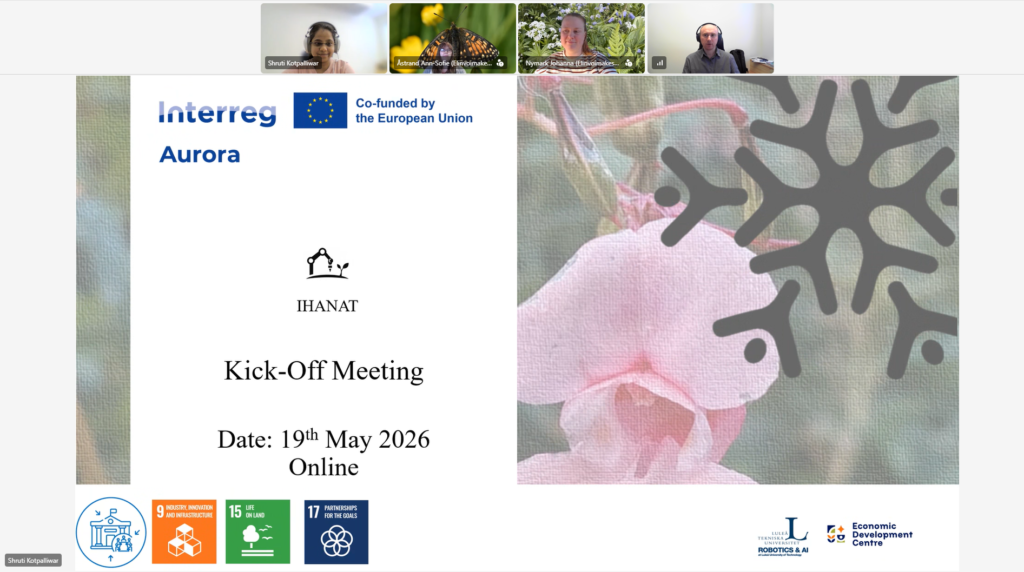
On 19 May 2026 the project partners Luleå tekniska universitet and Etelä-Pohjanmaan Elinvoimakeskus arranged a successful kick-off meeting for the project IHANAT – Idea-Hub for Arctic Nature and Technology project.
IHANAT is an Interreg Arctic Cooperation Clustering project financed by Interreg Aurora. The project brings together the project ROBODEMO financed by Interreg Northern Periphery and Arctic and the project INSPIRE financed by Interreg Aurora. The IHANAT project will combine the resources and skills of both projects to strengthen cross-border cooperation and build capacity for the robotics and digital technologies in environmental management.
The project focuses on supporting the detection and management of invasive alien species, Himalayan balsam, in Arctic and near-Arctic regions. During the kick-off meeting, the project partners discussed project objectives, planned activities, stakeholder engagement, and opportunities for knowledge exchange between ecological experts, technology developers, public authorities, and industry.
“We look forward to creating a strong cross-border network that connects nature and technology for smarter ecosystem management. Together, we are exploring how innovation can support biodiversity protection in the North”.
Himalayan balsam poses a major threat to biodiversity in Arctic and near-Arctic communities
Himalayan balsam (Impatiens glandulifera) is listed as an Invasive Alien Species of Union Concern under EU Regulation 1143/2014 and poses a major threat to biodiversity in northern Europe. It spreads rapidly along streams and riverbanks, outcompeting native vegetation and leaving soil bare after dying back in autumn, which increases erosion and degrades water quality. Additionally, Himalayan balsam is well suited for involving the public in control efforts: it is easy to recognize, its effects on the landscape are visible, and it can be removed manually.
Northern ecosystems have short growing seasons, and most have relatively low biodiversity, making them vulnerable to ecological disturbances. Climate change further accelerates the northward spread of invasive species, increasing risks of biodiversity loss. Monitoring Himalayan balsam is therefore essential for protecting Arctic and near-Arctic biodiversity.
Management of Himalayan balsam requires actions along entire rivers, which can be labor-intensive and dangerous due to steep or densely vegetated riverbanks. Himalayan balsam is an ideal case for testing drone-based detection methods that can improve the speed, safety, and efficiency of invasive species management.
Robotics and digital technologies in environmental management
Within the project IHANAT, drones will be used to collect aerial imagery of target areas. AI‑based image classification methods will then be applied to identify the presence or absence of Himalayan balsam. Drones can be used to survey stretches of rivers and gather areal images that allows machine‑learning models to classify the species from above and guide field teams to locations where removal is needed.
The project focuses on developing and sharing a practical framework for producing reliable location data for Himalayan balsam that can support environmental monitoring and future management decisions.
Collaboration between environmental authorities and universities working in environmental fields is common. However, cooperation between environmental authorities and university partners in robotics and AI is still rare.
Learn more about the project IHANAT- Idea-Hub for Arctic Nature and Technology