The Interreg Aurora funded project FOR-BLEND brings together RISE, the University of Vaasa and Åbo Akademi University to advance biofuel production, fuel testing and process simulation, strengthening the project’s pathway from pyrolysis oil to advanced hydrocarbon fuels.
As the transition away from fossil-based fuels accelerates, one central challenge is how to produce alternative fuels from residual biomass streams that would otherwise remain underused. The FOR-BLEND project addresses this challenge by developing ways to convert residual lignocellulosic streams into usable, high-quality fuel components. The project has now taken an important step forward, bringing together pilot-scale production, fuel analysis and process modelling as part of the same research pathway.
FOR-BLEND is a joint venture between RISE, the University of Vaasa and Åbo Akademi University. It is granted by Interreg Aurora and co-financed by Region Norrbotten and the Regional Council of Lapland.
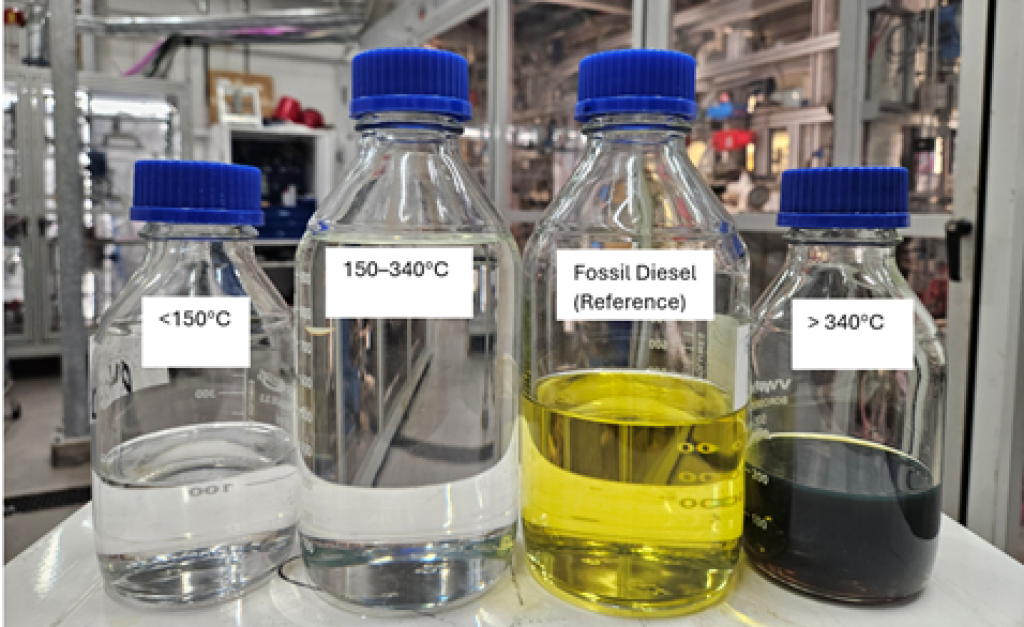
RISE recently succeeded at pilot scale using a two-step hydroprocessing approach to upgrade pyrolysis oil into advanced liquid biofuel. The first step was continuous slurry hydroprocessing, and the second step was continuous fixed-bed hydroprocessing. In total, 20 liters of final biofuel product were produced, with water content at ppm level and oxygen content below 0.2 wt%. The final biofuel product was distilled into naphtha, diesel-like and heavy residue fractions. The carbon recovery of the entire route from pyrolysis oil feed to liquid biofuel product was significant, reaching 70%.
This recent success strengthens RISE competence in developing advanced liquid fuels from lignocellulosic material, contributing an important step to research and development for the transition to a fossil-free society.

After the production milestone, the next question is how the upgraded product performs as a potential fuel component. At the University of Vaasa, this work focuses on the diesel-like fraction, distilled at 150–340 °C, and its suitability for further use in diesel blends.
The results so far are promising. Initial analyses show agreement with requirements given in standard EN590 for automotive diesel, indicating that the diesel-like fraction has characteristics worth further investigation. To better understand its blending potential, the product made by RISE was blended with fossil diesel, after which density and kinematic viscosity were measured. These measurements help identify interesting blend proportions for the next stages of analysis.
The work now continues with selected blends that will be evaluated for storage stability over several months. In parallel, material compatibility will be assessed using different metals and gasket materials. Together, these studies will provide important insight into whether the product, as a blend, could be potentially applicable for internal combustion engines. Further analyses will follow as the project continues to evaluate the fuel’s practical performance.
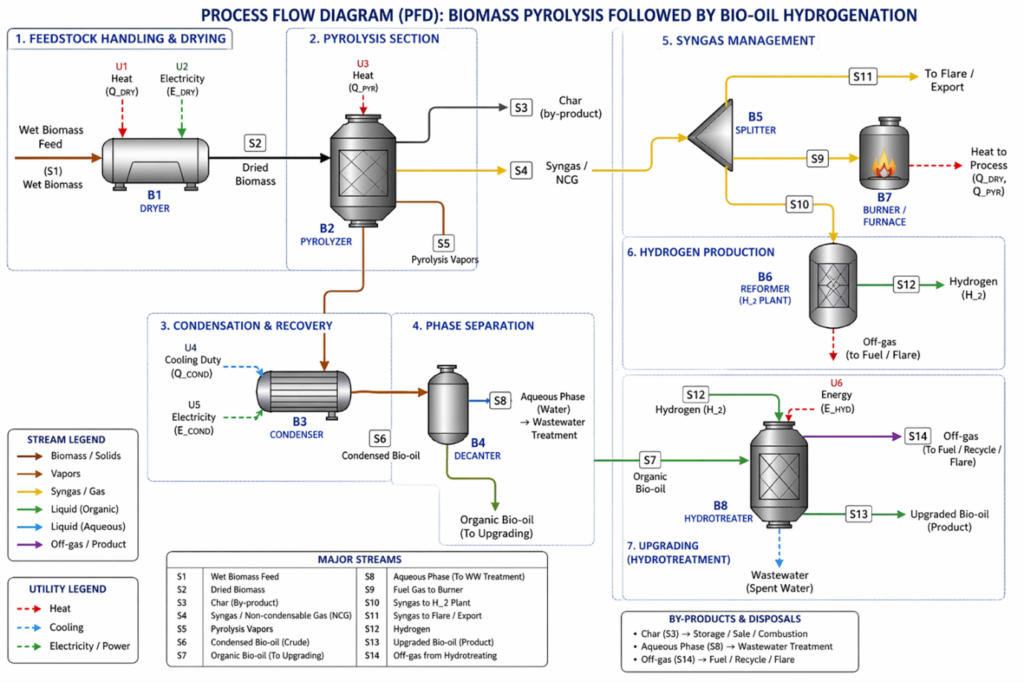
While RISE’s work demonstrates the production route and the University of Vaasa evaluates the fuel properties, Åbo Akademi University adds another important perspective: how the whole process behaves as an integrated system. In the FOR-BLEND project, the Laboratory of Energy Technology at Åbo Akademi University leads the process simulation and optimization activities. Within this scope, a mechanistic and dynamic process model has been developed to simulate the conversion of lignocellulosic biomass into upgraded hydrocarbon fuels via fast pyrolysis followed by hydrotreatment.
This modelling work helps connect the different stages of the conversion chain and gives the project a stronger basis for understanding performance, efficiency and scale-up potential. The modelling framework combines detailed reaction kinetics with global yield correlations and rigorous mass and energy balances, while also accounting for utility demands and process integration opportunities. This enables a quantitative evaluation of key performance indicators, including product yield distribution, hydrogen consumption, heat recovery potential, and the formation of gaseous by-products and char from the pyrolysis process.
The system boundary encompasses the full conversion chain, beginning with wet biomass entering the drying unit and extending to the final upgraded liquid fuel product exiting the hydrotreatment reactor. Key intermediate process stages include biomass drying, thermal decomposition via fast pyrolysis, vapor quenching and condensation, bio-oil phase separation, and subsequent hydrotreatment. By capturing the interactions between these unit operations, the model helps show not only how each stage performs, but also where the overall route can be improved.
In this way, the model serves as a decision-support tool for identifying process inefficiencies, operational bottlenecks, and integration opportunities. The overarching objective is to enhance process performance and reliability by aligning simulation insights with experimental findings, thereby supporting process scale-up, improving energy efficiency, and guiding the optimization of operating conditions within the FOR-BLEND project.
Together, the work of RISE, the University of Vaasa and Åbo Akademi University shows how FOR-BLEND is building a connected pathway from residual lignocellulosic streams to potential fuel components. By combining pilot-scale production, fuel-property evaluation and process simulation, the project strengthens both the technical understanding and the practical knowledge needed to support the development of advanced liquid biofuels for a fossil-free future.
Learn more about the Interreg Aurora project FOR-BLEND.