Photo: Linnea Bergdahl, County Administrative Board of Norrbotten
How important are estuaries for pike recruitment? Are there areas of estuaries that are more preferred than others by the pikes for spawning? And how does for example the type of shoreline and water-level fluctuations affect the abundance of young pike larvae?
These questions will be investigated in a study as part of the Interreg Aurora funded HIDDEN project. The study takes place in a number of different estuaries over the whole project area, all the way from Vaasa and Umeå in the south to the northernmost Bothnian Bay in the north. The same method for sampling and counting pike larvae and recording environmental data is used at all estuaries, which gives us a unique dataset of pike recruitment from Finland and Sweden combined.
As the spawning and hatching of pike is largely determined by water temperature, the field work for sampling the newly hatched pike larvae must follow the natural pace of increasing water temperatures after the ice melt. The Finnish coastline warms up first and colleagues at Luke in Finland started the field work in mid-May. Towards the end of May the pikes were ready and hatched along the coast in Västerbotten and in Norrbotten it took until early June before the pike larvae were hatched in the outermost areas and sampling could start.
Collected data will now be processed and analysed by the researchers at Luke and after a supplementary sampling round next spring, we will have the results and – hopefully – the answers to our questions about the pike’s recruitment in estuaries.
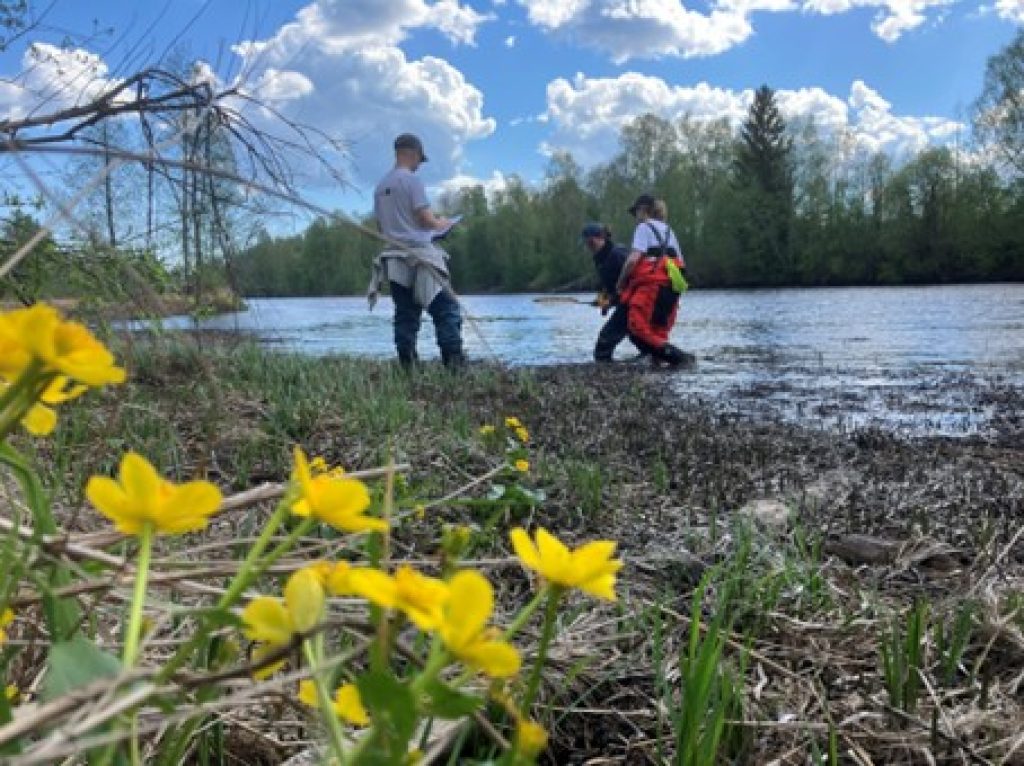
The newly hatched pike larvae can be found amongst the vegetation along the shoreline. By walking a certain distance along the shore and taking regular samples with the dip net, we can count how many pike larvae that are caught. After counting the larvae in the net, we release them directly back into the water.
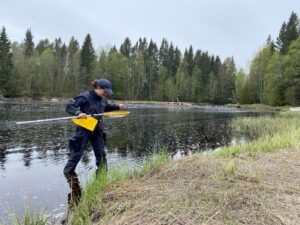
Photo: Anniina Saarinen, County Administrative Board of Västerbotten
Not only pike larvae can be caught in the dip net. The vegetation along the shore is often full of life – beetles, dragonfly larvae, snails, tadpoles and worms just to name a few.
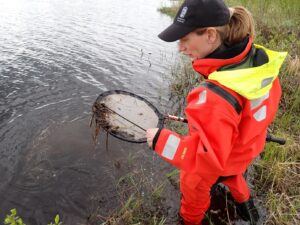
Photo: Anders Wallin, County Administrative Board of Norrbotten
A recently hatched pike, barely reaching 2 cm in length but already having the features of an adult pike.
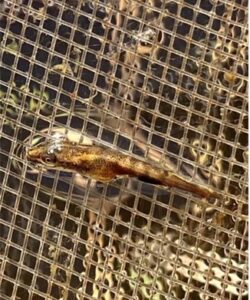
Photo: Anniina Saarinen, County Administrative Board of Västerbotten
Pike eggs caught on the dip net.

Photo: Anniina Saarinen, County Administrative Board of Västerbotten
Several environmental features are also recorded at each sampling site. We note for example the type of vegetation on the bottom along with temperature, pH and salinity of the water.
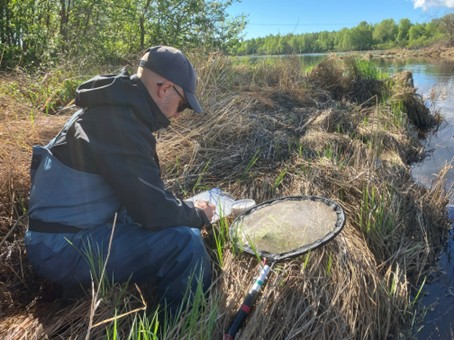
Photo: Linnea Bergdahl, County Administrative Board of Norrbotten.
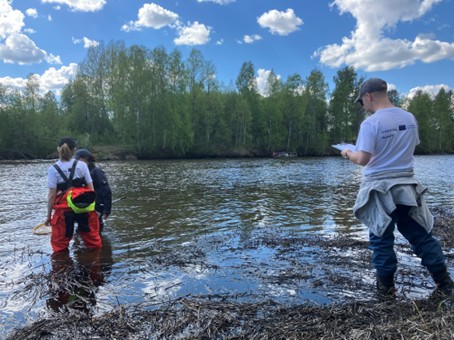
Photo: Anniina Saarinen, County Administrative Board of Västerbotten
It’s important that the sampling and recording is executed in the same way at all estuaries in Finland and Sweden. Planning and coordination between participating organizations and their staff has been a key part during the spring. In May we also met up for calibration of methods in the field.
Learn more about the Interreg Aurora project HIDDEN – Habitat Investigation in Diverse and Dynamic Estuarine Networks.