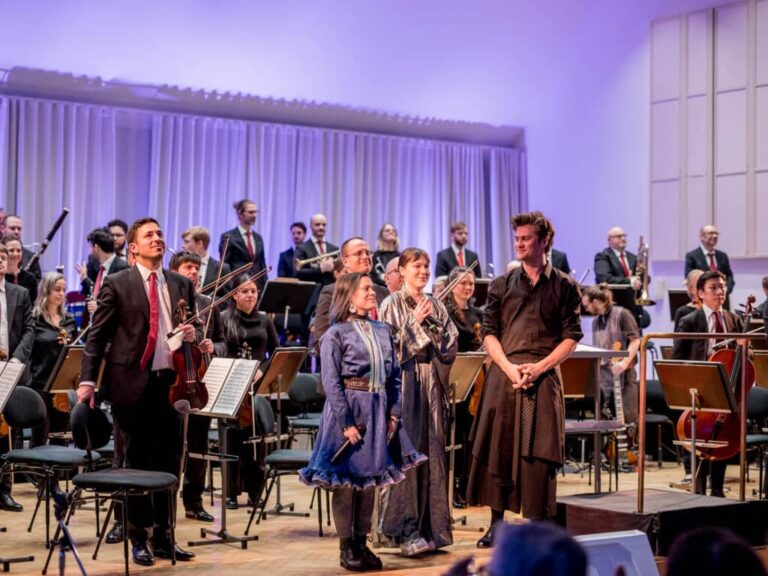

The two Interreg Aurora Steering Committees, for sub-area Sápmi and sub-area Aurora, met 21-22 January 2026 in Tråante/Trondheim to decide on new cross-border cooperation projects.
Funding was granted to 15 new projects in sub-area Aurora in the 7th call for Regular project applications. The approved projects will receive a total of approximately 10,2 million euros in funding from the European Regional Development Fund, and 1,25 million euros in Norwegian Interreg funding.
The funding will support a wide range of projects, including cooperation to attract skilled labour, strengthen business internationalisation, and enhance capacity for remote health care services.
Here you can find the List of all prioritized projects
Best wishes for a successful cross-border cooperation to all the new approved Interreg Aurora projects!
Funding decisions in sub-area Sápmi postponed until February 2026
Anna-Marja Kaddik, Chair of the Steering Committee for sub-area Sápmi, informs that the Sápmi Steering Committee has decided to postpone two funding decisions until February 2026. This decision is due to the current lack of Norwegian Interreg funding.
The Norwegian Managing Organisation decided that the upcoming 8th Interreg Aurora call for Regular project applications, opening in February 2026, will be closed for Norwegian project partners in sub-area Sápmi. Project applications in sub-area Sápmi involving Swedish and Finnish project partners can apply for EU-funding in the 8th call for Regular projects.
Norwegian project partners will, however, be able to apply for funding in the upcoming call for Small-scale projects, which will also open in February 2026.
Sámi organisations are encouraged to contact the Interreg Aurora Managing Authority or the Norwegian Managing Organisation if they have any questions regarding the Terms of Reference for the upcoming calls. Norwegian IR funding will be available for Regular project applications in the 9th call that opens in September 2026.

Attracting skilled labour, boosting business internationalisation, and supporting remote health care capacity
The Steering Committee for sub-area Aurora approved 15 new cross-border projects.
One of the approved projects is Talent North: Attracting and Anchoring Global Talent in the Arctic. The project will develop cross-border cooperation for better practices and services in the field of attraction, welcome, integration, and retention of global talent and skilled labour.
The project AISI – AI-supported internationalization in MSMEs aims to boost the competitiveness of companies in Northern Finland and Sweden by improving their readiness to export and capacity to use AI in international business. Through cross-border networking, and AI pilot projects, companies will learn to spot international market opportunities, build effective export processes, and establish sustainable partnerships.
Another approved project, AI-HEALTH Nordic: AI-Powered SmartCare for Remote Communities, will focus on how digital solutions can strengthen local healthcare capacity and make rural health systems more sustainable. Small and medium-sized companies, healthcare providers, and research institutions will work together to co-develop digital tools.
Ulrica Hammarström, Chair of the Steering Committee for sub-area Aurora, states that important funding for cross-border cooperation has been allocated to a wide range of projects that address real challenges and possibilities in the regions. By working through consensus, the Steering Committee gains valuable insights into the needs and priorities of each region and diverse stakeholders.
Ulrica Hammarström highlighted that the Steering Committee for sub-area Aurora welcomes applications under Priority 2: Green and Sustainable Transition in the upcoming calls. When the Interreg Aurora programme was written, all regions agreed that climate change adaptation, nature protection and biodiversity, and sustainable mobility are key priorities for cross-border cooperation. The Steering Committee also welcomes project applications that involve small and medium-sized companies and NGOs.
Trøndelag welcomed the Interreg Aurora Steering Committees
Rolv Dahl, Head of Section for Industry and Business at Trøndelag fylkeskommune, welcomed the Steering Committees to Trøndelag, which is part of Interreg Auroras geographical sub-area Sápmi. Sámi culture and identity form an essential part of the region, with ongoing initiatives to support the South Sámi language, cultural heritage, and local business development.
The first Sámi national meeting was held in Tråante/Trondheim on 6 February 1917, uniting Sámi people across borders. This historic event is the reason 6 February is celebrated today as the Sámi National Day.
Trøndelag is a leading centre in Norway for education, research, and innovation in agriculture, aquaculture, technology, medicine, oil and gas, and shipping. An Ocean Technology Centre is going to be built in Tråante/Trondheim, set to become one of the world’s most advanced facilities for marine technology research and education. Trøndelag celebrates its rich food traditions, rooted in local heritage.
Casandra Grundstrom, Associate Professor at the Norwegian University of Science and Technology (NTNU) was invited to the meeting to present the recently completed Interreg Aurora project, Nordic Health Data Spaces. The project focused on assessing the Interreg Aurora programme areas readiness to implement the European Health Data Space (EHDS). The EHDS regulation creates a common EU framework for sharing and using health data across borders, improving patient access, supporting research, and enabling safer, more efficient cross-border health care.
The project has developed strategies, policies, and technical requirements, and has identified the skills and capacity needed for successful adoption of the European Health Data Space. A key achievement is the creation of a MOOC (Massive Open Online Course), which has successfully engaged 108 learners.

Upcoming calls for new project applications
The Interreg Aurora programme will open new calls for both Small-scale and Regular project applications on 9 February 2026. The calls will close on 9 March 2026.
It is important to read and check the Terms of Reference before applying, since there are limitations in the upcoming calls.
Read more about upcoming calls and Terms of Reference