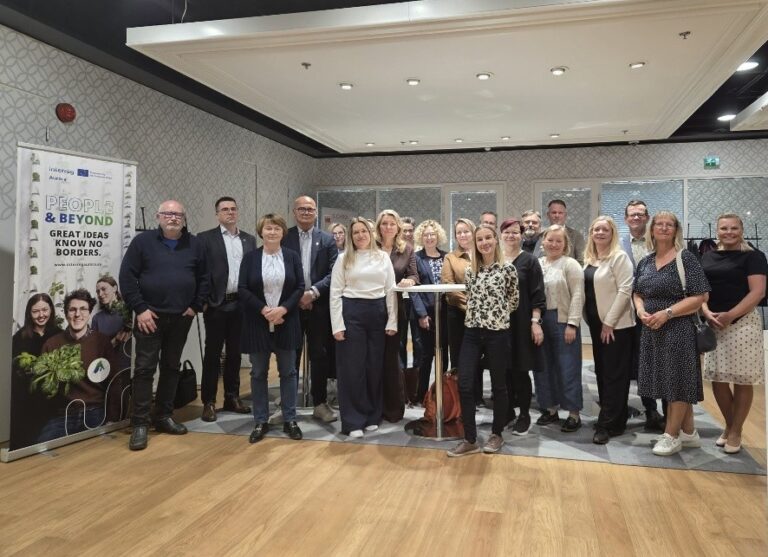

People are the foundation of all cross-border cooperation. Interreg Aurora is happy to present the people and different professions working across borders with the aim to improve our daily lives.
Meet Anna Tervonen, Project Manager, Kajaani University of Applied Sciences (KAMK)
My name is Anna Tervonen, and I am a Project Manager at Kajaani University of Applied Sciences (KAMK). I have worked the past eight years in international projects. My project experience, however, goes back to 2011 when I worked for a regional development company. I studied International Business at KAMK in Kajaani, Finland, as well as in Germany.
It is a great pleasure for me to have returned to KAMK as an employee and to be able to contribute to cross-border development in various sectors. I have been involved in several Interreg Aurora projects, mainly related to circular economy topics such as waste management, nutrient recovery, textile waste management and wastewater management. My work covers the full project cycle – from idea generation and concept development to proposal writing and project implementation.

Cross-border cooperation benefits both the environment and local communities
Environmental challenges do not stop at national borders. Cross-border cooperation in waste management and the circular economy is particularly important in the Aurora programme area because the area is sparsely populated. This making it inefficient – or even impossible – for each country to build a full set of specialized waste-treatment facilities on its own.
The Nordic countries are global leaders in circular economy solutions, which creates a strong foundation for technology exchange, harmonization of legal frameworks, collaborative initiatives, and joint research and development projects. Ultimately, both the environment and local communities’ benefit from shared expertise, improved practices, and more efficient resource use.
Soft skills and personal communication matter most for successful cooperation
The best thing about working in a cross-border project is the people. Throughout project idea generation, concept development, and proposal writing, you meet many inspiring individuals from diverse backgrounds and with different areas of expertise. Over years of cooperation, many project partners become not just colleagues but friends—people with whom you share laughter, challenges, deadlines, and even the occasional sauna.
Despite the rapid growth of digitalization, AI, and machine learning, personal communication will always remain central to exploring collaboration opportunities and successfully implementing development projects.
Kajaani University of Applied Sciences seeks new project partners
I would recommend applying for Interreg Aurora projects. The Interreg Aurora programme officers provide excellent support for applicants and project managers from the earliest idea stage all the way to project closure. Having also worked with other EU-funded projects, I can highlight the relatively low administrative burden within Interreg Aurora. The programme team is understanding, flexible, and always willing to find solutions to potential challenges. It is also worth acknowledging the valuable support provided by the Regional Council of Lapland.
The only potential challenge is finding new, suitable project partners for emerging project ideas. However, even in those cases, the Interreg team actively assists in facilitating possible collaborations.
Kajaani University of Applied Sciences (KAMK) is keen to connect with new potential project partners and showcase the expertise and knowledge that KAMK can bring to new cross-border cooperation projects.
A future where circular initiatives circulate seamlessly across borders
I’ve learned that circular economy progress depends on cooperation across borders. Working in the Aurora programme area has shown how shared challenges can become shared opportunities when we combine expertise, scale up solutions, and harmonize our practices. Solutions co-developed by international teams are more sustainable than anything developed in isolation. Again, I want to highlight the importance of soft skills and communication in multidisciplinary, international teams.
My wish for the future is that cross-border cooperation becomes the norm—not the exception. I hope that, with the support of the Interreg Aurora programme, we continue breaking down administrative barriers, sharing knowledge openly, and designing solutions that work across borders.
Waste streams, materials, waters, and environmental impacts do not stop at national borders. I would like to see a future where circular economy initiatives are truly international – where innovations, technologies, resources, and benefits circulate seamlessly across borders.

Learn more about the Interreg Aurora funded projects Sustainable Nutrients, Prowater and NOWA
#InterregAurora #CrossborderCooperation #PeopleandBeyond #KAMK