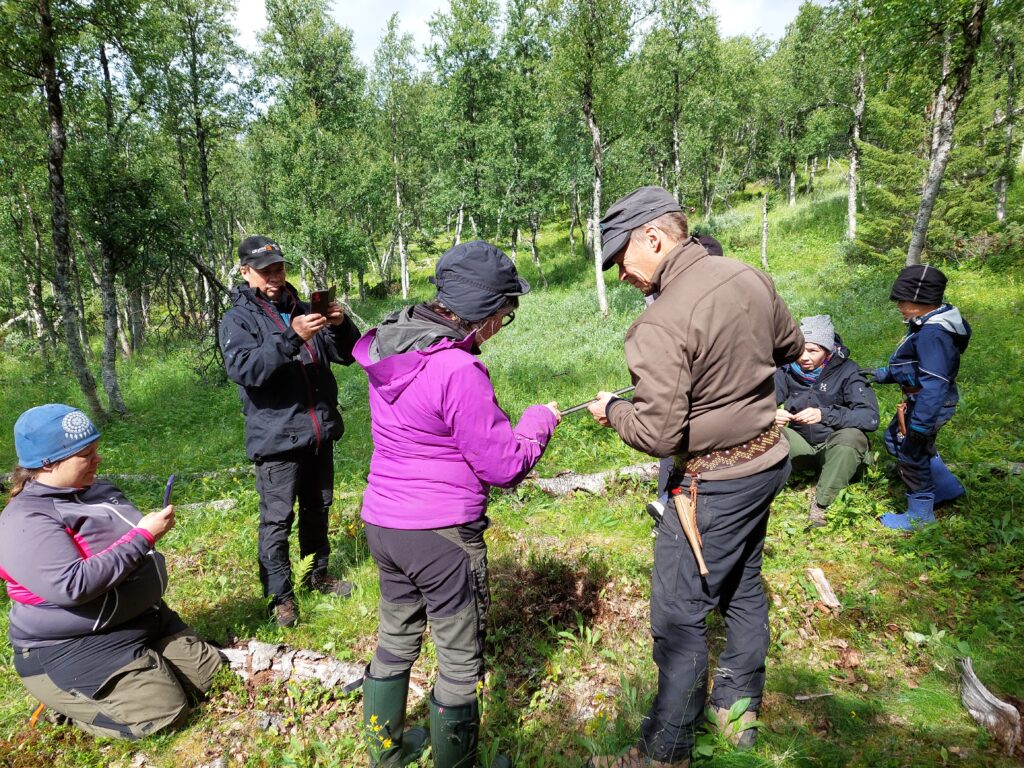
Photo: Camilla Olofsson Båatas
The Sámi have always moved seamlessly across the South Sámi area. Historical and archaeological research therefore needs to be conducted across national borders in Norway and Sweden in order to create the conditions necessary to understand South Sámi history. For this reason, Mid Sweden University and Gïelem nastedh have initiated a project.
Participants include the Sámi villages of Ohredahke, Jijnjevaerie, Njaarke, Handölsalens, Tossåsens and Ruvhten sijte, as well as the reindeer herding districts of Låerten Sijte, Fovsen Njarke Sijte and Skæhkeren Sijte.
The overall aim of the project is to implement the South Sámi community’s right to education and knowledge about its own history on equal terms with the majority population and in culturally appropriate ways. The project will build infrastructure for, and create conditions for, research on South Sámi history and place and landscape names, in which traditional knowledge (for example, knowledge of reindeer herding and its use of the landscape) is accorded the same value as academic knowledge.
Mutual understanding and respect for traditional Sámi and academic knowledge
The ambition is to promote mutual trust, respect and understanding between the South Sámi community and researchers, and to place traditional and academic knowledge systems on an equal footing. The project will build a robust foundation for future research, identify research questions that are relevant to the South Sámi community, and establish networks between academia in Åarjelsaepmie, Gïelem nastedh in the municipality of Snåsa, Sámi villages, reindeer herding districts, and South Sámi individuals with an interest in history.
Through three digital workshops, participants will gain basic knowledge of how archives can be used and how historical research is conducted (from an academic perspective), as well as how to carry out fieldwork, inventory and register cultural heritage sites on their lands (from other Sámi). Only then will Sámi stakeholders have equal conditions for forming an informed view of what kind of research they would like to see.
At the same time, researchers will gain a basic understanding of Sámi culture and traditional Sámi land use, thereby creating the conditions for conducting sound and relevant research. It is hoped that collaboration with the Sámi community and teaching about colonial archives relevant to the Sámi villages will provide researchers with new ideas for relevant research. The project includes a workshop in Snåsa to jointly formulate questions for future research on South Sámi archaeology and history.
The project also aims to encourage young Sámi to pursue higher education and to research, write about, and teach their own history. The project is funded by Interreg Aurora Sápmi, with co-funding from Region Jämtland Härjedalen, Trøndelag County Council, and the Sámi Parliament in Norway.
The project leaders are Camilla Olofsson Båatas, Administrative Officer for Saami Matters and Lecturer in South Saami history at Mid Sweden University, and Hanne-Lena Wilks, Head of Gïelem nastedh, the South Sámi Language Centre of the municipality of Snåsa.
Contact: Project leader, Camilla Olofsson Båatas, Mid Sweden University, camilla.olofssonbaatas@miun.se